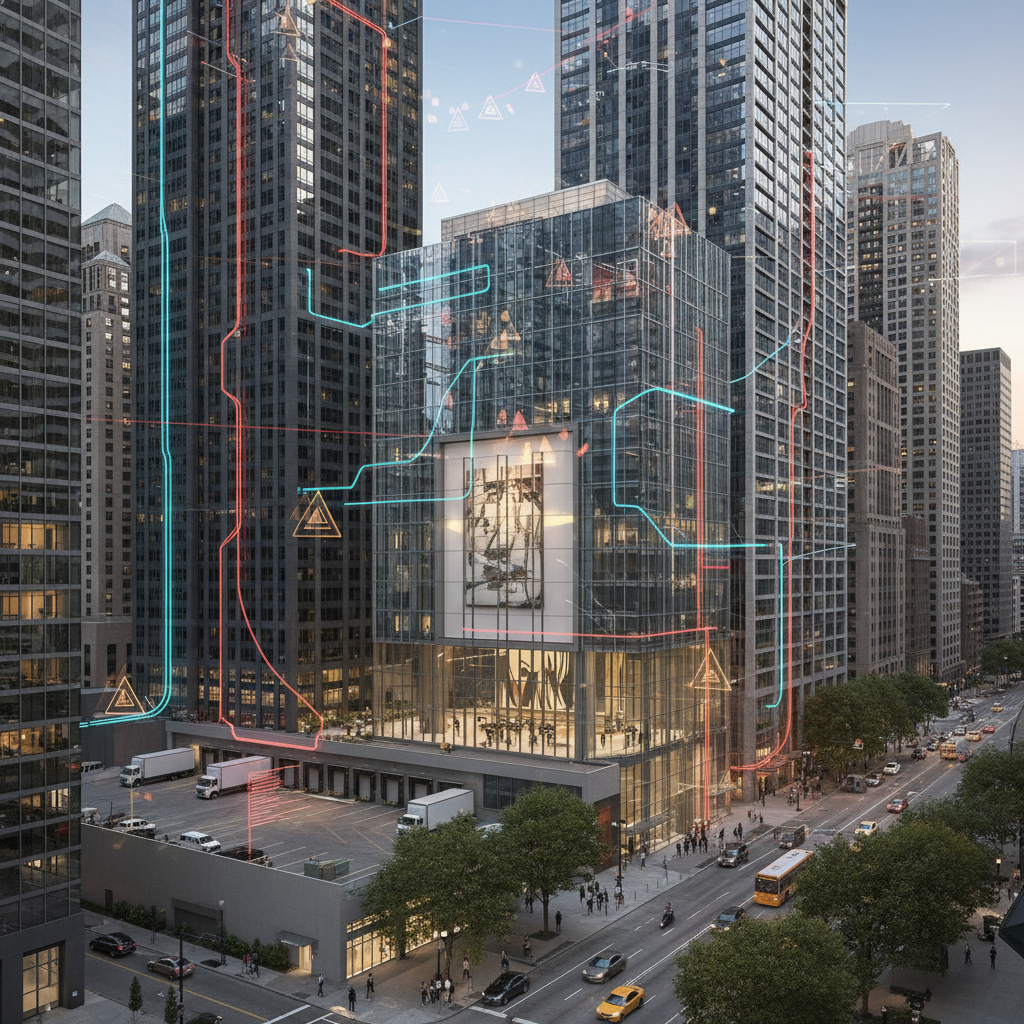
Crisis Resilience
Know how your Building Brain performs under stress.
MovementAI helps owners test whether the asset can Build enough context, Flow safe interventions, and Sync useful evidence during outages, labor gaps, access disruption, weather pressure, and compound operating stress.
"A strong Crisis Resilience Score gives owners a clearer risk story for operators, insurers, lenders, and capital partners."
How It Works
Stress-test the building story before the real event
01
Use a safe copy
MovementAI tests a copy of the building's operating pattern, so the live building and daily operations are not affected.
02
Run five realistic stress scenarios
The copy is tested against events owners and insurers care about: outage, low occupancy, labor shortage, access disruption, and compound stress.
03
Produce an owner score
The result is a simple Crisis Resilience Score that helps owners discuss readiness, risk controls, insurance evidence, and next improvements.
5 Crisis Archetypes
The Exact Conditions Most Likely to Generate Insurance Claims
Archetype weights: Alpha=30%, Beta=20%, Delta=20%, Gamma=15%, Epsilon=15%
ARCHETYPE Alpha · WEIGHT 30%
Grid outage
Duration: Two-hour stress scenario
Stress scenario
Elevators, power, lighting, and comfort systems are constrained at the same time.
Owner questions answered
- Can people and service teams still move safely?
- Does the system recommend usable emergency actions?
- Can the owner prove what was done?
- Does the building avoid false confidence?
ARCHETYPE Beta · WEIGHT 20%
Sudden occupancy change
Duration: Multi-day stress scenario
Stress scenario
Occupancy drops or shifts quickly, changing normal building patterns.
Owner questions answered
- Does the building understand that the day is unusual?
- Can it avoid overreacting to temporary changes?
- Can it surface unused capacity as an opportunity?
ARCHETYPE Gamma · WEIGHT 15%
Labor or vendor shortage
Duration: One business week scenario
Stress scenario
Key vendors, contractors, janitorial, or service teams are unavailable.
Owner questions answered
- Can essential work be rerouted?
- Can the team see which services are most exposed?
- Can shared-vendor risk across buildings be identified?
ARCHETYPE Delta · WEIGHT 20%
Access disruption
Duration: One-hour stress scenario
Stress scenario
Credential, lobby, turnstile, or access systems slow down during a busy period.
Owner questions answered
- Can the team keep people moving safely?
- Does the right person get alerted fast?
- Can the event be documented for risk review?
ARCHETYPE Epsilon · WEIGHT 15%
Compound bad day
Duration: Ninety-minute stress scenario
Stress scenario
Power limits, weather, vendor gaps, robots or vehicles, and tenant activity collide at once.
Owner questions answered
- Can the system explain what is driving pressure?
- Can it recommend safe actions under multiple constraints?
- Can the owner see the full story afterward?
What goes into the score
40%
Prediction
Did the system see the risk early enough?
25%
Safe action
Did the recommended action stay within safety and operating rules?
20%
Speed
Did the action appear fast enough for the team to use?
15%
Capacity judgment
Did the building correctly understand how much capacity was really available?
Score Interpretation
What the Crisis Resilience Score Means
≥ 85
CRS
Certified Crisis Resilient
Publishable to insurance underwriters and institutional capital partners as a positive actuarial input.
70–84
CRS
Conditional
Operator notification required. Recalibration recommended before next deployment expansion. Re-evaluation within 30 days.
< 70
CRS
Needs Improvement
Owner and operator attention required. Keep the system in advisory mode while the team improves weak areas and retests.
Insurance + Owner Evidence
A clearer crisis-readiness story for underwriting and risk review.
The Crisis Resilience Score helps owners show how the asset may respond under stress, what actions are available, and where the next improvements should be made before real disruption occurs.