
Prepared for Mr. Ron Domingo II
From Morning Surprise toPredictive USPS Readiness
Mr. Domingo, we're pleased to share a proposed MovementAI and Quotron pilot for USPS Largo: MovementAI predicts late mail and parcel arrival risk plus daily manpower gaps before they break the day, while Quotron displays zone-specific readiness signals throughout the post office.
Pilot Site
USPS Largo Post Office
50 8th Ave SW, Largo, FL 33770-9998 is a movement-dense postal node where route readiness, package flow, dock timing, retail pressure, carrier departure, dispatch protection, late volume, and call-off volatility collide every day.
Largo becomes the proof site for moving USPS from morning surprise to predictive readiness. MovementAI turns those signals into intelligence. Quotron turns that intelligence into live physical awareness.
Carrier routes
35–65
Daily route pressure becomes a live display signal for supervisors and carrier staging areas.
Packages
3k–6k/day
Parcel volume, exceptions, and package-assist pressure can be converted into zone-specific tickers.
Vehicle movements
80–170+/day
Inbound, outbound, carrier departures, returns, and dispatch windows can be surfaced at the dock and exit.
Manpower coverage
50–90 people
Daily staffing, call-offs, and available support can be compared against actual parcel and mail volume without employee-surveillance framing.
National USPS Operating Problems
The pilot should directly address the two problems USPS feels every morning.
Largo becomes more than a local demonstration. It becomes a proof point for how a Building Brain can help USPS manage late upstream processing volume, late station arrivals, and manpower volatility with the same dynamic intelligence used by modern logistics, hospitality, and high-throughput service operations.
1. Late-arriving parcels and mail
Across USPS facilities, including Largo, one of the largest daily operating risks is late parcel or mail arrival at two levels: late arrival into the processing facility upstream, and late arrival from the processing network into the local station. Either delay can compress the morning and threaten carrier departure, dock flow, and dispatch windows.
Building Brain response
MovementAI treats upstream and station-level lateness as readiness signals, not surprises. If processing-facility arrival, station ETA, unload completion, or sortation timing begins drifting, the Building Brain can trigger an early Intervention Card so supervisors can re-sequence staging, adjust route readiness priorities, and protect the morning departure window before the delay cascades.
2. Call-offs and manpower mismatch
The second national pressure point is labor coverage. When people call off work, the branch still has the same mail, parcel, retail, pickup, and dispatch obligations. Static staffing assumptions do not match the daily reality of volume volatility.
Building Brain response
MovementAI gives USPS a restaurant-style labor intelligence layer: compare today's actual volume against available manpower, calculate the capacity gap, and recommend where to shift support. Instead of guessing whether the team can clear the load, the branch sees the manpower needed for the day it actually has.
Early sight
Late mail and parcel risk becomes visible before it breaks route readiness, whether the delay starts upstream or at the local dock.
Hospitality-grade labor logic
Daily volume is matched against available people, similar to high-performing restaurant staffing tools.
Capacity impact
Call-offs translate into route, dock, retail, and dispatch risk instead of remaining anecdotal.
Dynamic load factor
Performance expectations adjust to the actual parcel, mail, and staffing load of the day.
MovementAI Role
The intelligence engine.
MovementAI connects approved USPS operating data, learns daily branch rhythm, detects pressure before it spreads, and generates Intervention Cards for supervisors, dock flow, route readiness, dispatch protection, upstream processing delays, station-arrival risk, and call-off capacity gaps.
It remains the Building Brain: the system that decides what is building up, what is at risk, what needs to move, and what changed after action was taken.
Quotron Role
The physical visibility layer.
Quotron units can become polished, always-on live ticker surfaces for zone-specific MovementAI outputs: route risk, dock pressure, dispatch countdowns, late-arrival alerts, manpower capacity gaps, package pickup flow, and customer-safe service notices.
The strategic upgrade is simple: the post office does not just get a dashboard. The building starts speaking in real time.
Quotron Research Summary
What Quotron brings to the pilot.
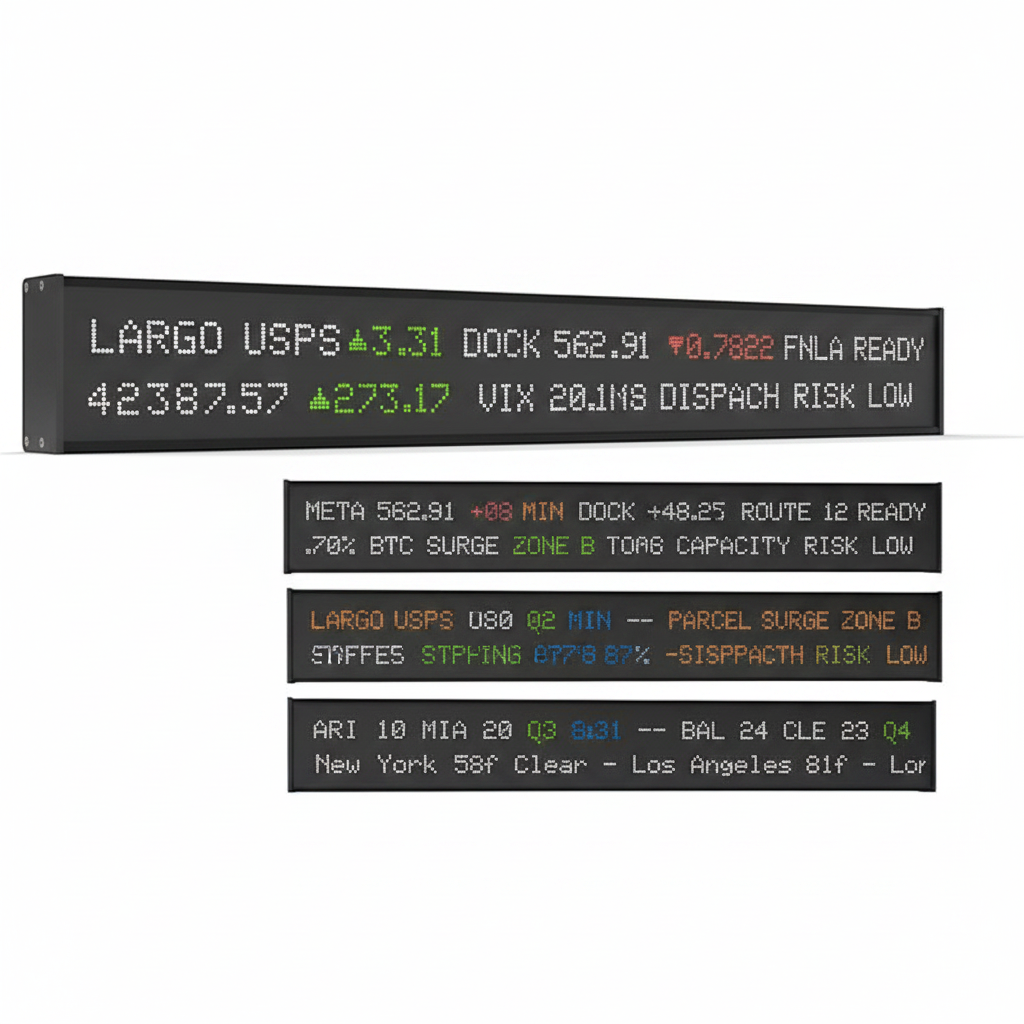
Actual Quotron Wolf / Classic-Style Device
A longer Quotron ticker unit helps USPS reviewers understand the proposed physical display layer: an always-on LED strip that can translate approved MovementAI signals into clear zone-specific awareness.
Visualization: AI-edited from a longer Quotron-style product reference to show USPS facility-data use cases.
Integrated Architecture
MovementAI decides what matters. Quotron makes it visible.
The combined pilot turns the Building Brain into a physical operating layer inside USPS Largo, while keeping approved USPS systems as the source of truth and Quotron as the live display surface.
Approved USPS signals
Route volume, processing-facility timing, station-arrival timing, aggregate manpower capacity, call-offs, dispatch windows, staging pressure, package exceptions, retail flow, and supervisor notes.
MovementAI Building Brain
Qualifies pressure, forecasts risk, creates Intervention Cards, and decides which message belongs in each postal zone.
Quotron stream layer
Converts approved readiness intelligence into zone-specific ticker streams with different content rules for internal and public areas.
Physical displays
Live operational intelligence appears where action happens: dock, carrier staging, supervisor area, lobby, pickup, and dispatch exit.
Pilot Guardrails
Low-friction, practical, and safe for the branch.
The first phase is designed to feel manageable for USPS Largo: no disruption to operations, no employee-surveillance framing, and no requirement to install new infrastructure before the value is proven.
Works WITH existing systems
MovementAI connects to approved data USPS systems already create — databases, route records, package tracking, truck logs, and timing notes, where available. Nothing is replaced.
Facility-flow focus
The pilot is focused on facility flow, route pressure, dispatch protection, staging, and service improvement — not individual staff monitoring.
No heavy installation first
The first step is analysis and proof using existing operational data. Sensors, feeds, or deeper integrations are recommended only after the white paper shows where they are worth it.
Built for daily operations
The output is plain-language action: what is building up, what is at risk, what needs to move, and what changed after action was taken. Existing systems continue as normal.
Plain Data Categories
Pilot data should be simple to explain.
Pilot data is organized into clear categories so the Largo Postmaster and authorized USPS reviewers can see what MovementAI reads, how each signal is used, and why it matters.
Route data
Volume by route, route readiness, carrier departure and return timing, exception counts, and package-assist pressure.
Manpower capacity
Aggregate staffing plan, call-off count, available manpower by function, and capacity fit against the day’s parcel and mail load.
Building data
Dock activity, staging congestion, hamper flow, customer pickup pressure, PO Box activity, and blocked movement zones.
Time data
Processing-facility timing, station-arrival timing, unload timing, dispatch cutoffs, peak periods, late-day recovery, and recurring daily pressure cycles.
Approval & Data Boundaries
Respecting USPS process from the start.
USPS-approved access only
MovementAI works only with data access, observation, and operating context that USPS and the branch approve.
No assumed integrations
Deeper system connections happen only if the Largo Postmaster and appropriate USPS stakeholders agree they are useful and permitted.
Lightweight first step
The pilot can begin with non-disruptive branch context and expand only when the findings support a deeper Building Brain roadmap.
Technical Guardrails
The integration should be impressive, but controlled.
Quotron becomes strategically valuable only if it can operate as a secure, permissioned display endpoint for MovementAI intelligence inside a USPS-approved pilot environment.
Custom feed validation
Quotron must confirm that MovementAI can send custom operational streams, not only market or sports feeds, with acceptable update latency.
Central content control
Each device should be managed by zone, with templates, brightness, speed, schedule, message priority, and offline behavior controlled centrally.
USPS-safe networking
Deployment should respect USPS-approved Wi-Fi, device-registration, power, mounting, data-retention, and cybersecurity requirements.
Permissioned content
Customer-facing displays must never expose internal route risk, aggregate manpower constraints, security events, or person-level personnel signals.
Where The Integrated Pilot Helps
The same postal pressure points, now visible in the building.
MovementAI identifies operational pressure before it spreads; Quotron turns the right warnings into live, zone-specific awareness for the people closest to the decision, especially when upstream processing delays, station-arrival risk, or call-offs threaten the day’s plan.
Late route departure risk
Parcel surges, upstream processing delays, station-arrival drift, vehicle constraints, and overloaded routes can push carriers out late before supervisors have enough warning.
Late-arrival black box
Late parcels or mail arriving to the processing facility upstream, or late-arriving volume from the processing network into Largo, can break the morning before supervisors have enough early sight to adjust staging, route priority, or carrier readiness.
Parcel exception drag
Missorts, missed scans, oversized items, and late-arriving parcels force manual searching and interrupt route readiness.
Call-off capacity gap
When people call off, supervisors need to know whether today's actual volume can still be cleared with the manpower available, not yesterday's fixed staffing assumption.
Dynamic load factor
Daily volume volatility should adjust performance expectations, labor allocation, and intervention urgency instead of treating every morning as the same operating load.
Blocked-flow risk
Backroom movement between people, vehicles, carts, packages, and staging zones creates safety and throughput risk.
Approved Data Inputs
Start with USPS signals the branch already understands.
The integrated pilot still begins lightweight: MovementAI reads approved operating data, including late-arrival and manpower signals where available, then converts only the right outputs into Quotron streams.
Not every input becomes a display message. Manpower data is treated as aggregate staffing capacity only, never person-level monitoring; restricted or sensitive signals remain limited to authorized USPS review.
From Scattered Signals To Physical Intelligence
The integrated pilot closes the gap between data and action.
The original USPS pilot proves that MovementAI can read branch movement. The integrated pilot adds the physical display layer that makes approved intelligence visible at the point of work.
Current state
Integrated pilot state
Display Placement Strategy
Each Quotron unit gets a job based on where it lives.
Instead of one generic screen, USPS Largo would receive a zone-based visibility layer: each display shows only the intelligence relevant to the physical decisions made in that area.
Supervisor command
Branch pulse, route-risk mix, dock pressure, dispatch countdown, and top Intervention Cards.
Dock / receiving
Processing delay risk, station ETA, unload targets, hamper flow, staging capacity, and arrival-delay ripple risk.
Carrier staging
Route readiness, package-assist needs, departure waves, route exceptions, and final sweep prompts.
Retail lobby
Public-safe wait times, pickup reminders, service windows, holiday notices, and customer instructions.
Package pickup / PO Box
Pickup pressure, hold-for-pickup volume, ID reminders, PO Box flow, and peak-window alerts.
Break room
Daily focus, safety reminders, non-surveillance wins, operating proof, and end-of-day improvement notes.
Dispatch / vehicle exit
Vehicle readiness, pending routes, cutoff timing, return-flow forecast, and recovery window status.
Building Brain Visibility Layer
Real-time MovementAI metrics become live Quotron ticker intelligence.
Each zone receives a different approved signal stream, turning late-arrival risk, manpower gaps, and abstract branch movement data into immediate physical awareness.
Building Brain
MovementAI reads approved branch signals, qualifies urgency, and routes the right message to the right Quotron display.
Supervisor Command
Branch Pulse
Dock / Receiving
Arrival Readiness
Carrier Staging
Route Readiness
Retail Lobby
Customer Load
Pickup / PO Box
Pickup Pressure
Example Ticker Streams
The message changes by zone, audience, and permission level.
MovementAI would create concise action-ready messages for late-arrival risk, manpower capacity, dispatch protection, and customer-safe service updates; Quotron would render them as ambient operational awareness in the physical branch.
Public displays show only customer-safe service information. Internal displays show operational pressure, late-arrival alerts, manpower gaps, and Intervention Cards.
Supervisor
LARGO PULSE: PARCEL LOAD 4,820 | MANPOWER GAP 2.5 HRS | ROUTE RISK 7 YELLOW / 3 ORANGE
Dock
PROCESSING ARRIVAL DELAY RISK: ORANGE | STATION ETA 8:12 AM | UNLOAD TARGET 8:45 | STAGING B NEAR CAPACITY
Carrier staging
ROUTE READINESS 42/58 GREEN | PACKAGE ASSIST NEEDED: 14, 22, 31 | WAVE 1 TARGET 9:10 AM
Retail lobby
PACKAGE PICKUP VOLUME HIGH | PLEASE HAVE ID READY | PASSPORT HOURS 10 AM–2 PM
Dispatch exit
DISPATCH CUTOFF 1H 05M | ROUTES PENDING 6 | RETURN FLOW PEAK 4:15–5:20 PM
Staff area
TODAY'S FOCUS: COVERAGE GAP ON ROUTES 14/22 | PROTECT DISPATCH WINDOW
Command Preview
The dashboard remains the control room; Quotron becomes the live signal strip.
Live Building Brain
Largo Operating Command
5,900
Parcels
11
Routes at risk
2.5 hrs
Manpower gap
18 min
ETA drift
Late Arrival Readiness Curve
Required Load vs Available Manpower
Intervention Cards for Branch Operations
What the system delivers every day
Route C14 is 38% above normal parcel load
HighShift 18 large parcels to package-assist before 9:10 AM.
Processing-to-station mail flow is trending 18 minutes late
HighRe-sequence dock staging and protect carrier wave 1 before the late arrival cascades.
Call-offs create a 2.5 labor-hour gap
MediumMove available support to routes 14 and 22 before retail lunch pressure begins.
Route C07 recovered
ProofEarlier parcel staging reduced projected departure delay by 16 minutes.
Recommended Rollout
Add Quotron without making the pilot feel heavy.
The safest strategy is to keep MovementAI as the first proof layer, then use Quotron displays as a controlled physical-output pilot once the right messages and permissions are approved.
Phase 1
Validate fit
Confirm Quotron can accept MovementAI custom streams, manage multiple devices, and separate public vs internal content.
Phase 2
Configure streams
Define message templates for late processing risk, station-arrival risk, call-off capacity gaps, dock, staging, supervisor, lobby, pickup, staff, and dispatch zones.
Phase 3
Install units, Ron's choice
Quotron will supply as many pilot units as USPS Largo determines are needed, with Mr. Domingo selecting the starting zones, such as supervisor command, dock/staging, and retail-safe lobby displays.
Phase 4
Expand Building Brain visibility
Add zone-specific units only after USPS Largo confirms which locations create daily operating value.
The Path We Are Proposing
From pilot insight to fully plugged-in Building Brain.
The pilot is not the final product. It is the first step in a clear path: collect approved data, identify operational insight, document plug-in requirements, then support a full-time intelligence layer once the right signals are connected.
The pilot is intended to provide USPS Largo with practical near-term insight and a clear path for evaluating future modernization opportunities.
1. Start with approved USPS operating data
The pilot begins with lightweight operating data: parcel and mail counts by route, carrier departure and return times, processing-facility and inbound station timing, dispatch cutoffs, route exceptions, retail pressure windows, call-offs, available manpower, and supervisor notes.
2. Analyze movement for hidden pressure
MovementAI looks for repeated bottlenecks, overloaded routes, late-arrival ripple effects, staging-zone friction, scan gaps, staffing mismatch, dynamic load-factor gaps, dispatch risk, and overtime exposure before those issues become service problems.
3. Deliver the Largo Building Brain white paper
At the end of the pilot, USPS Largo receives a practical white paper showing what was found, what improved, which late-volume and manpower signals mattered most, and what the branch could install or connect to fully plug in the Building Brain.
4. Define the full plug-in blueprint
The blueprint may recommend data feeds, scanner exports, dock timing capture, route dashboards, low-friction zone sensors, vehicle/staging visibility, queue measurement, or other branch-specific infrastructure.
5. Activate the full Building Brain
Once the final data connections and sensors are in place, MovementAI becomes the live intelligence layer: monitoring pressure, producing Intervention Cards, forecasting risk, and creating daily operating evidence.
6. Become the long-term data partner
The Largo proof model can support a long-term Building Brain partnership for the branch and broader USPS delivery-unit modernization.
Implementation Roadmap
A clear path from first data review to full Building Brain integration.
The pilot is designed to be easy to understand: start with what the branch already knows, analyze late-arrival and manpower volatility for hidden insight, validate value with Intervention Cards, then deliver a white paper that identifies what to connect next for the full Building Brain.
Kickoff & branch walk-through
Understand how the Largo branch actually moves every morning, afternoon, and dispatch cycle.
A simple movement map of the branch and a short list of the highest-value signals to collect first.
Initial data collection
Start with data the branch already has or can capture with minimal extra work.
A baseline view of normal branch rhythm, daily pressure points, and recurring operational friction.
MovementAI analysis layer
Analyze movement patterns to find where small delays become route, labor, dispatch, or customer problems.
Early insight report showing where the Building Brain can create immediate operating value.
Intervention Card pilot
Give USPS Largo supervisors plain-language recommendations they can use during the workday.
A working preview of what the Building Brain feels like inside daily postal operations.
White paper & plug-in blueprint
Give USPS Largo a clear written roadmap for fully connecting the branch to MovementAI.
The Largo Building Brain white paper: findings, recommended plug-ins, cost-saving logic, and next-step integration plan.
Full Building Brain integration
Once recommended data feeds and sensors are in place, activate the full-time intelligence layer.
MovementAI becomes the full-time data partner and operating brain for the branch.
The destination is a long-term operating intelligence partnership.
Once the recommended approved data connections, optional sensors, or operating feeds are in place, MovementAI becomes the always-on Building Brain: a unified intelligence layer above existing systems, watching late volume, manpower capacity, route pressure, and dispatch risk while recommending action, documenting outcomes, and helping the branch improve every day.
Install / connect signals
Activate Building Brain
Long-term data partner
Final Pilot Deliverable
The Largo Building Brain White Paper.
The pilot ends with a formal USPS review document that explains what was learned, which connections matter most, and how Largo can move from lightweight analysis to a full Building Brain integration.
Pilot findings
Plug-in blueprint
Building Brain integration
This makes the next step concrete: identify the most valuable data feeds, sensors, or operating connections required for MovementAI to become the branch’s full-time intelligence layer.
Branch Requirements
What USPS Largo would need to provide.
The integrated pilot adds a physical layer, so the branch needs the original data and walk-through support plus clear approval for display placement, content permissions, and network constraints.
Recommended first display proof: supervisor command, dock/staging, and one customer-safe lobby or pickup-area ticker.
Pilot Success Metrics
How Largo proves predictive readiness.
The pilot wins if USPS can see late volume and manpower volatility earlier, make better same-day staffing and routing decisions, and document fewer avoidable recovery events.
Earlier warning minutes
How many minutes before a late processing or station-arrival delay becomes visible to supervisors.
Late-route exposure
Whether routes at risk of delayed departure are identified earlier and reduced during the pilot.
Manpower allocation fit
How accurately available aggregate staffing capacity is matched to the day’s actual parcel and mail load.
Dispatch-risk events
Whether dock, staging, route, and dispatch pressure events are reduced after Intervention Cards.
Manual recovery time
How much supervisor recovery time is avoided when late volume and call-off pressure are surfaced earlier.
Potential Time & Cost Savings
How the Building Brain can turn small daily wins into major operating value.
These charts are pilot assumptions, not guaranteed results. They show the savings logic: if MovementAI helps the branch see late volume earlier, match available manpower to the actual daily load, stage parcels smarter, protect dispatch windows, and reduce manual recovery work, even small time savings compound quickly across a high-motion postal facility.
8–12 hrs/day
Potential labor exposure saved if the Building Brain helps recover 10–15 minutes across roughly 50 carriers.
$60k–$180k/yr
Illustrative annual operating-value range from lower overtime, fewer delay recoveries, and better route balancing.
25–45%
Potential reduction in repeated pressure events after late-volume, route, dock, dispatch, and staffing patterns are identified.
Carrier Time Recovery
Estimated saved labor hours if daily carrier friction is reduced.
Pressure Event Reduction
Illustrative daily issue counts before and after Building Brain Intervention Cards.
Daily Operating Pressure Curve
The goal is not to remove volume; it is to flatten avoidable pressure before it spreads.
Pilot Outcomes
What USPS Largo gets from the combined pilot.
The goal is not to install screens for novelty. The goal is to prove that live physical intelligence can reduce friction, protect dispatch windows, improve branch awareness, and show USPS how the Building Brain responds to upstream processing delays, station-arrival risk, and call-off manpower volatility.
Timeline
Use the existing 8-week USPS pilot as the baseline, with Quotron layered in carefully.
The Quotron layer should begin as a technical validation and small physical proof, then expand only after the MovementAI white paper identifies the highest-value display zones.
Week 1
Discovery & Baseline
Walk the building, map movement zones, confirm route groups, processing-facility and station arrival windows, parcel staging areas, retail pressure points, call-off patterns, and current pain points.
Weeks 2–3
Signal Capture
Start with lightweight daily inputs: parcel and mail volume by route, carrier departure/return times, processing-facility and inbound truck timing, call-offs, available manpower, dispatch risk, queue pressure, and manual exceptions.
Weeks 4–5
Intervention Card Pilot
Launch morning route pressure cards, late-arrival readiness alerts, manpower capacity prompts, dock/dispatch alerts, and end-of-day operating proof summaries.
Weeks 6–7
Refinement
Tune thresholds with USPS Largo supervisors, compare predictions to outcomes, and identify the highest-value recurring bottlenecks in late volume and manpower volatility.
Week 8
Pilot Readout
Deliver the Largo Building Brain report: measured wins, avoided delays, manpower allocation evidence, peak-season readiness, and scale plan for other delivery units.
Final Recommendation
Make Largo the first proof that USPS can turn morning surprise into predictive readiness.
MovementAI and Quotron are strategically complementary: one understands postal movement; the other gives that understanding a physical voice inside the building.
The combined pilot should be positioned as a low-friction modernization path: approved USPS data first, MovementAI analysis second, zone-specific Quotron displays third.
If Quotron confirms custom feeds, central management, secure deployment, update latency, offline behavior, and permissioned content streams, Largo can prove a repeatable USPS operating model for managing late volume and manpower volatility with a visible Building Brain.
Prepare the integrated pilot conversationIntegrated pilot URL
/usps-integrated-pilot